Integration
- Integration
- Plugins
- Integration Guide Shopware 6
- Integrationsanleitung Shopware 6
- Integration Guide Magento 2
- Integrationsanleitung Magento 2
- Integration Guide Shopware 5
- Integrationsanleitung Shopware 5
- Integration Guide WooCommerce
- Integrationsanleitung WooCommerce
- Integrationsanleitung Oxid 6
- Integration Guide Oxid 6
- Integrationsanleitung Oxid 7
- Integration Guide Oxid 7
- Installationsanleitung Magento 1
- Integration Guide Magento 1
- Channel-Server-API
- Server API - Preauthorization
- Server API - Authorization
- Server API - Capture
- Server API - Refund
- Server API - Debit
- Server API - Managemandate
- Server API - Getinvoice
- Server API - Getfile
- Server API - Vauthorization
- Server API - Creditcardcheck
- Server API - Getuser
- Server API - Updateuser
- Server API - 3dscheck
- Server API - Bankaccountcheck
- Server API - Addresscheck
- Server API - Createaccess
- Server API - Updateaccess
- Server API - Updatereminder
- Server API - General Interface Definitions
- Server API - checkout demo app
- Channel-Client-API
- Client API - Preauthorization
- Client API - Authorization
- Client API - Creditcardcheck
- Client API - Managemandate
- Client API - General Interface Definitions
- Client API - Createaccess
- Client API - Vauthorization
- Client API - Bankaccountcheck
- Client API - AJAX-Mode
- Client API - Redirect-Mode
- Client API - Addresscheck
- Client API - Hosted iFrame Mode
- Client API - Calculation of the HASH value
- PAYONE Link
- Channel-Frontend
- Response Handling
- Testdata
- NEW Hosted Tokenization Form
- Plugins
Introduction
Our OXID 6 plugin is regularly updated and provides a versatile, ready-to-use solution for easy online payment acceptance.
Supported Payment Methods
💳 Credit Cards
- Visa (Click to Pay), Mastercard (Click to Pay), American Express
- JCB, Diners Club
📱 Wallets
- Apple Pay
- Google Pay
- PayPal and PayPal Express
- PayPal v2 and PayPal Express v2
- Alipay
- WeChat Pay
- WERO
🏦 PAYONE Solutions
- PAYONE Secure Invoice
- PAYONE Secured Invoice, Secured Direct Debit and Secured Installments
- PAYONE Direct Debit
- PAYONE Open Invoice
- PAYONE Prepayment
🌍 Additional Payment Methods
- Klarna Payments
- Ratepay Invoice, Direct Debit and Installments
- Unzer Invoice, Direct Debit and Installments
- Bancontact, EPS, iDEAL
- PostFinance Card and E-Finance
- Przelewy24
Requirements
Plugin Installation
You have 2 options to install our plugin:
Installation via Composer
OXID 6 uses Composer for dependency management, so our extension is also installed via Composer. Please follow these steps to install the extension:
SSH into the directory of your OXID composer.json file and run the following command:
Installation via GitHub
Download the latest version directly from GitHub and install it manually in your OXID 6 installation.
Portal Configuration
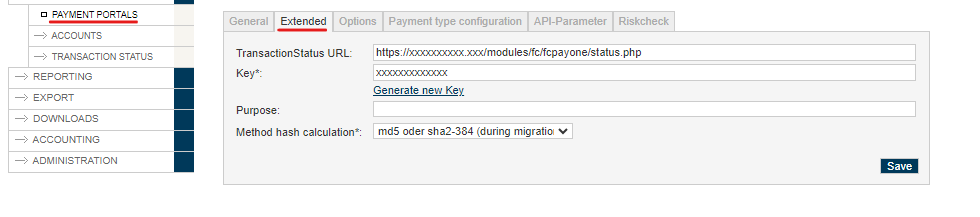
To send the transaction status to the correct address, please log in to the PAYONE Merchant Interface (PMI).
Navigate to: Configuration → Payment Portals → YOUR_PORTAL → Advanced → TransactionStatus URL
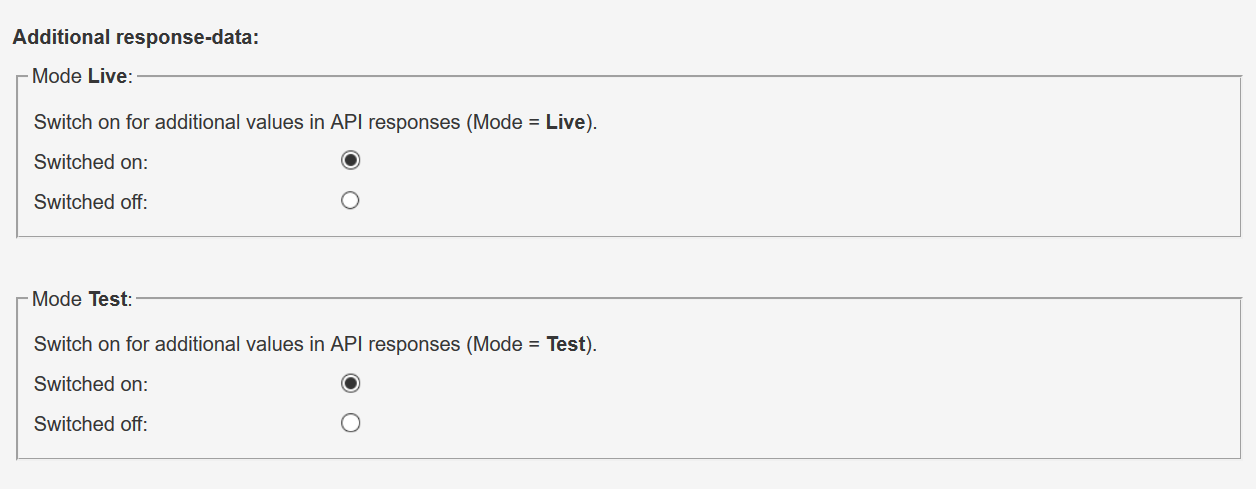
Additional Response Data
Under General, set the Additional Response data for both Live and Test modes to "on".
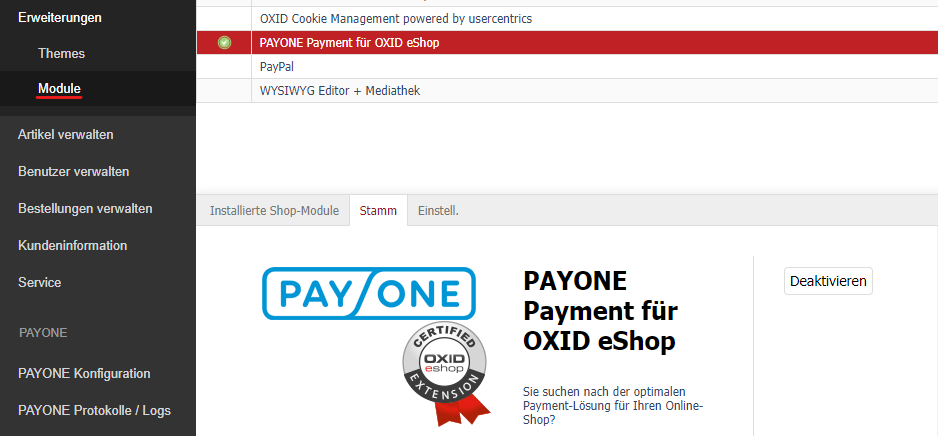
Admin Configuration
Activate the module in the OXID backend.
Payment Methods Configuration
Under Configuration → Payment Methods, both the standard payment methods of your OXID eShop and the payment methods available via PAYONE are displayed. Here you can configure the desired payment methods.
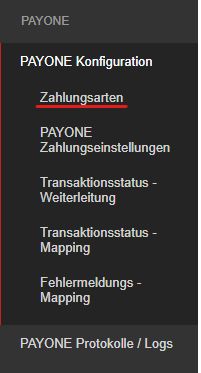
The PAYONE payment types are an extension of the OXID standard payment types and offer additional options. To display only the PAYONE payment types, use the filter function PAYONE Only in the header of the payment type table.

Overview
The overview shows you all PAYONE payment methods that are available for configuration. Please only configure the payment methods that have been activated for your merchant account.
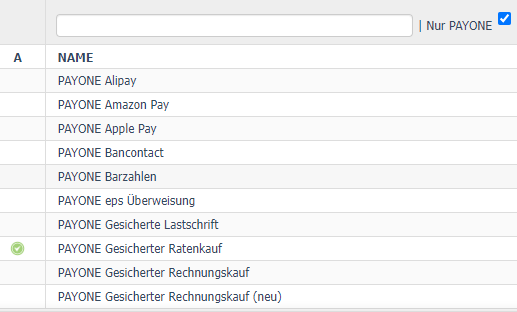
You can recognize all PAYONE payment methods by the displayed logo.
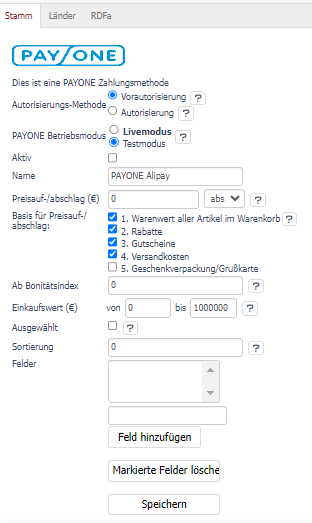
| Field | Description |
|---|---|
| Authorization Method | Pre-authorization - The amount to be paid is reserved. In this case, the debit must be captured in a second step during shipping. Authorization - The amount to be paid is immediately debited when the order is placed. The claim is immediately posted on the PAYONE platform. |
| PAYONE Operating Mode | Here you can specify for the respective payment type whether the payments are to be processed in test mode or whether they are to be executed "live". You can also configure the test mode for individual payment types. |
| Active | Determines whether the payment method is available in the checkout process. |
| Name | Name of the payment method, which will be displayed in the checkout. |
| Price Surcharge/Discount | abs - indicates the absolute price (e.g. if you enter 7.50, 7.50 euros will be charged). % - calculates the price in relation to the shopping cart value. (Example: enter "2", 2% of the cart value will be added). You can also enter negative values. |
| Min. Credit Rating | Here you can specify that certain payment types are only available to users/buyers who have at least the defined creditworthiness index. You can enter the credit rating index for each user under the menu item Manage User → User → Advanced. |
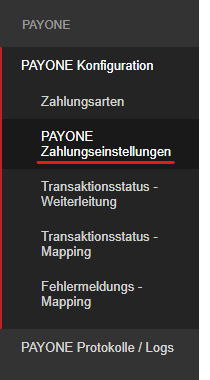
The global configuration settings for communication with the PAYONE platform are made under PAYONE → Configuration → PAYONE Payment Settings.
Connection Settings
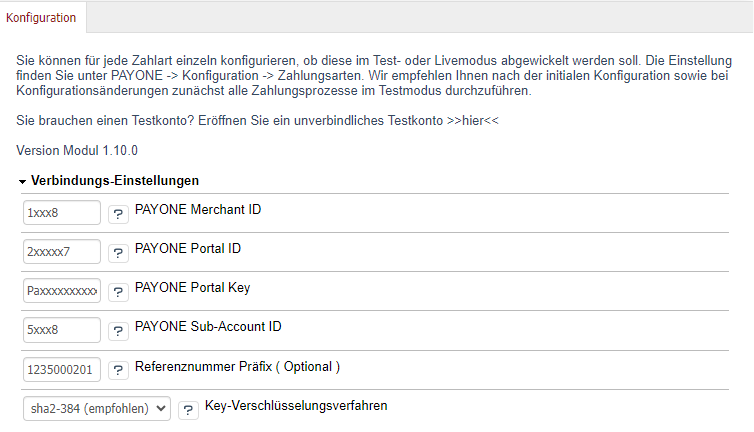
| Field | Description |
|---|---|
| PAYONE Merchant ID | You will find your PAYONE Merchant ID at the top right of the PAYONE Merchant Interface (PMI) and on all PAYONE invoices. |
| PAYONE Portal ID | Please enter the ID of the PAYONE payment portal you want to use to process the payments. The Portal ID can be found in the PAYONE Merchant Interface (PMI) under the menu item Configuration → Payment Portals. |
| PAYONE Portal Key | The configuration can be found in the PAYONE Merchant Interface (PMI) under the menu item Configuration → Payment Portals → [Edit] → Tab [Advanced] → Key |
| PAYONE Sub-Account ID | Please enter the ID of the sub-account you want to use to process the payments. The ID can be found in the PAYONE Merchant Interface (PMI) under the menu item Configuration → Accounts |
| Reference Number Prefix | Here you can configure how the reference number is supplemented to ensure uniqueness for the transfer to PAYONE.
This setting is required, for example, if you are running the extension on a test system and a production system.
|
| Hash Method | This setting corresponds to the hash setting in your payment portal.
The PMI and shop settings have to match for credit card payments to work correctly. We strongly recommend setting both to sha2!
|
General Information

| Field | Description |
|---|---|
| Send Article List | Here you can configure that the article information is also transferred to PAYONE.
This option only needs to be activated if you have booked the Invoicing module with PAYONE.
|
| Save Order Before Authorization | Here you can define whether the order is already saved before the payment confirmation. These orders are then in a wait status. |
Special Customizations
The Creditcard payment method in the extension is divided into various subtypes (card brands). You can activate or deactivate the respective card type in the overview. You also have the option of assigning countries from which you wish to accept the card to the respective card brand. In addition, you can set for each credit card brand whether it is activated in live or test mode.

Credit Card Configuration
The OXID Extension offers you the conformity with the "lowest" Compliance Level according to PCI DSS (SAQ A). Since in this compliance level all credit card data may only be entered in fields hosted by a PCI DSS certified service provider, our extension uses iFrames that are integrated into the checkout. However, these do not inherit the CSS of the shop template, but contain their own style. You can use the following settings to customize these fields.
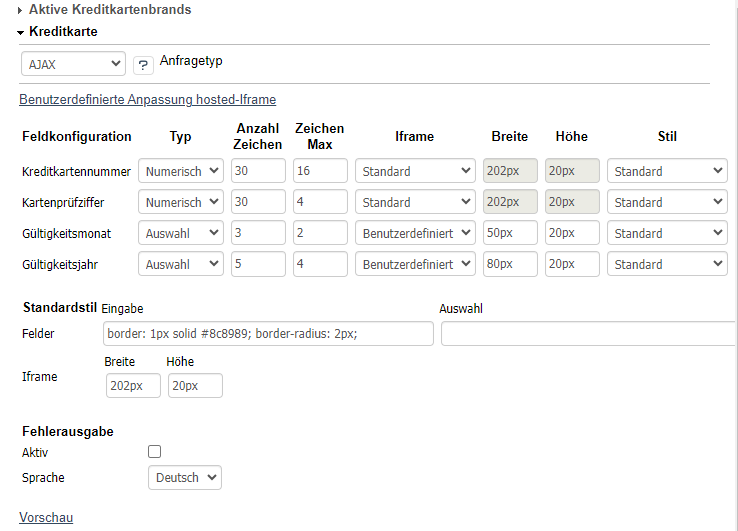
| Field | Description |
|---|---|
| Request Type |
Make sure to always use "hosted iFrame". Only merchants with a PCI DSS certification level of SAQ A-EP or greater are allowed to use AJAX. We still strongly suggest using hosted iFrame!
|
| Input Configuration | Here you can set separate parameters for the individual fields of the credit card query. |
| Type | Numeric - Only numbers are allowed and for mobile devices the numeric keyboard is used input type="tel". Password - input type="password" Text - input type="text" Selection - drop-down list |
| Digit Count | Length of the field in characters (HTML attribute size) |
| Max Digits | Maximum length of input (HTML attribute maxlength) |
| Iframe | Standard - Uses width and height from standard style Custom - Uses width and height from the following fields |
| Width | CSS - Specify width |
| Height | CSS - Indication of height |
| Style | Standard - Uses CSS specification from Standard Custom - Uses CSS specification from the following field |
| CSS | Specification of CSS properties for field
The use of the attribute "url" leads to a non-display of the field
|
| Standard Style | |
| Input Fields | Input - CSS specification for all input fields (HTML input) Selection - CSS specification for all selection fields (HTML select) |
| Iframe | Width - CSS specification Height - CSS specification |
| Error Output | |
| Active | Enables error output in checkout related to credit card entries. |
| Language | Selection of the display language for the error messages. |
Requirements
- Apple Pay and the desired card brands (Visa, Mastercard, American Express, Girocard) are included in your PAYONE contract
- The shop is accessible exclusively via HTTPS
- Access to the Apple Developer Portal
- Access to the PAYONE Merchant Interface (PMI)
1. Apple Developer Portal
Create Merchant ID
Navigate to Certificates, Identifiers & Profiles → Identifiers → "+" → Merchant IDs and assign an identifier following the pattern merchant.com.yourdomain.shop. This value will later be entered in the shop.
Payment Processing Certificate
This certificate enables the PAYONE platform to decrypt the Apple Pay payment data. It is stored exclusively in the PAYONE Merchant Interface, not in the shop.
- Create a Certificate Signing Request (CSR) in the PAYONE Merchant Interface
- Upload the CSR at developer.apple.com
- Download the resulting certificate in .cer format
- Upload the file again in the PAYONE Merchant Interface
Merchant Identity Certificate
This certificate is used to validate the Apple Pay session and is stored in the shop.
openssl req -new -key merchant_id.key -out merchant_id.csr -subj "/CN=merchant.com.yourdomain.shop/C=DE"
Upload the CSR in the Apple Developer Portal under Merchant Identity Certificate, download the certificate and convert it to PEM format:
This results in the two files merchant_id.pem and merchant_id.key.
Domain Validation
Navigate to Merchant ID → Merchant Domains → Add Domain and place the file provided by Apple in the web root of your shop:
Verify that the file is accessible in the browser, then click Verify in the Apple Developer Portal.
2. Configuration in the OXID Backend
The configuration is done under PAYONE → PAYONE Configuration → PAYONE Payment Settings → Configuration → Apple Pay.
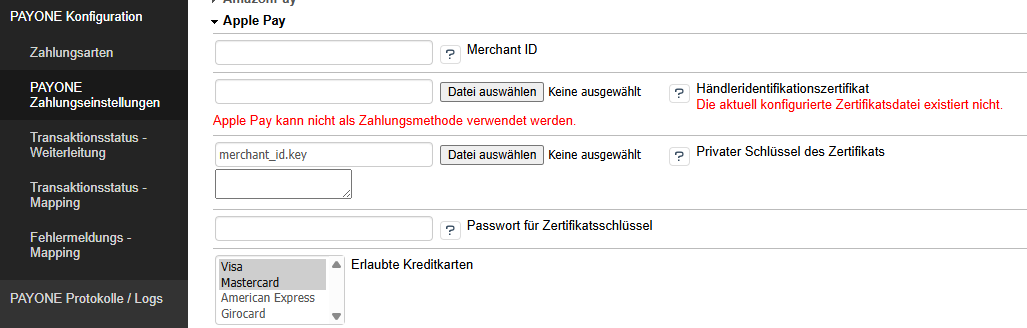
| Field | Description |
|---|---|
| Merchant ID | The identifier of your Merchant ID from the Apple Developer Portal, e.g. merchant.com.yourdomain.shop |
| Merchant Identification Certificate | The Merchant Identity Certificate in .pem format. Certificate and private key are stored in the shop directory upon upload. |
| Private Key of the Certificate | The corresponding private key in .key format. |
| Password for Certificate Key | Only required if the private key was created encrypted. |
| Allowed Credit Cards | Selection of the card brands offered in the Apple Pay dialog: Visa, Mastercard, American Express, Girocard. Multiple selection with Ctrl or Cmd. |
3. Activate the Payment Method
- PAYONE → PAYONE Configuration → Payment Methods: activate Apple Pay and set test or live mode
- Shop Settings → Payment Methods: activate the payment method, check country and user group assignment
- Shop Settings → Shipping Methods: assign Apple Pay to the relevant shipping methods
In the direct debit area, you can make settings with regard to the SEPA procedure (Single European Payments Area).
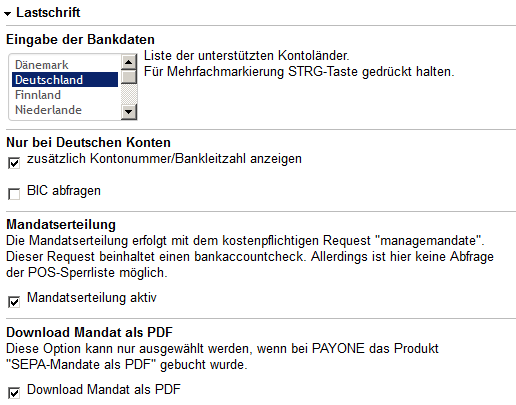
| Field | Description |
|---|---|
| Countries | Selection of countries for which direct debit may be offered. |
| Account Number Display Bank Sort Code | For German accounts, it is still possible to display the account number and bank sort code in addition to the IBAN / BIC. With this selection you activate the display. |
| Active Mandate Allocation | Activates the mandate management of PAYONE. |
| Download Mandate as PDF | Here you can define whether the buyer receives a download of the mandate from PAYONE at the end of the checkout. |
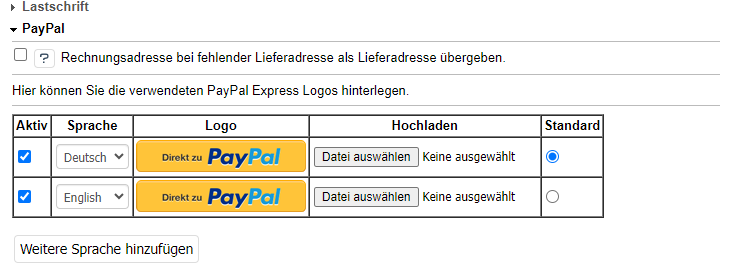
| Field | Description |
|---|---|
| Use Billing Address as Shipping Address | If no explicit delivery address or a different delivery address has been specified, the billing address will be transmitted as the delivery address for the payment method PayPal - if the checkbox is activated. |
| Active | Activates the entry |
| Language | Language to which this entry applies. Only languages created in the OXID eShop are displayed. |
| Logo | Preview of the uploaded logo, which will be used later in the checkout. |
| Upload | At this point the logo can be selected. |
| Standard | If activated, the entry or logo of this entry will be the default for all languages where no logo is available. |
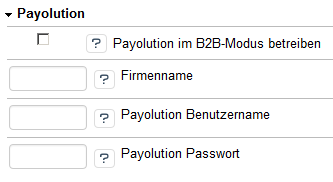
| Field | Description |
|---|---|
| Operate in B2B Mode | If the B2B mode is activated, it is automatically assumed that it is a B2B transaction if the "Company" field was executed when entering the address. To check the creditworthiness of the company, further information such as the commercial register number is then requested in the checkout. |
| Company Name | The full name of the company must appear here. The name will be used in the privacy policy. |
| Unzer Username | In order to retrieve the installment purchase draft contract, the user name assigned by Unzer must be stored here. |
| Unzer Password | The password assigned by Unzer must be stored here in order to retrieve the installment purchase draft contract. |
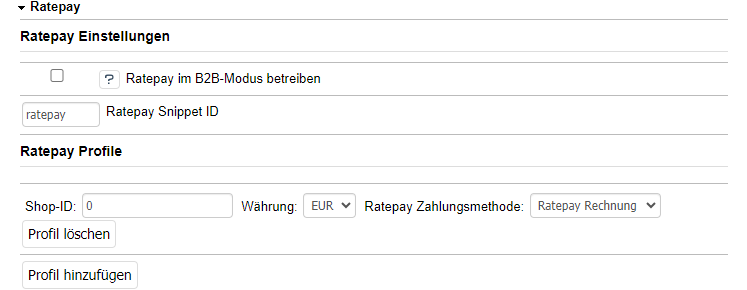
For Ratepay Invoice to work, please add your profile ID and provide the corresponding currency.
When B2B mode is activated and the company name specified by the user, the VAT ID no. is requested. For B2C customers the date of birth is requested instead.
These two payment methods require their own payment portal. Please enter under Customers → Payments → PAYONE → Configuration → applies to payment method: PAYONE Secured Invoice bzw. PAYONE Secured Installment a separate portal ID.
Advanced Configurations
Here you will find separate setting options that allow you to customize our plugin more precisely to your needs.
Under the menu item PAYONE → Protect you can configure credit and address checks as well as bank account checks.

Here you can specify for the credit standing check whether the checks are carried out in test or live mode.
Credit Assessment
Here you can specify whether and in what form creditworthiness checks are to be carried out during the checkout process.
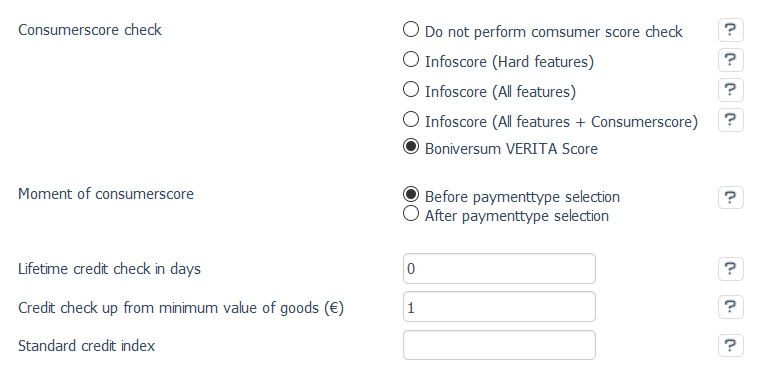
| Field | Description |
|---|---|
| Consumer Score Check | Do not perform consumer score check - no request is made to the PAYONE platform. Infoscore (Hard features) - Checking for hard characteristics via infoscore (e.g. consumer insolvency proceedings, arrest warrant for affidavit or enforcement of affidavit) Infoscore (All features) - Examination for so-called "hard" negative features (see above) and "medium" negative features (e.g. order for payment order, enforcement order or enforcement) and "soft" negative features (e.g. collection dunning procedure initiated, continuation of out-of-court collection dunning procedure after partial payment, discontinuation of out-of-court collection dunning procedure due to hopelessness) Infoscore (All features + Boniscore) - Checking for all characteristics (see above) and delivery of the BoniScore, which as a score value enables a higher selectivity for existing negative characteristics. Boniverse VERITA Score - Check for VERITA-Scores via Boniversum |
| Moment of Consumer Score | Before payment type selection After payment type selection - you can select the creditworthiness index for the payment type so that a check is only carried out for certain payment types. |
| Lifetime Credit Check in Days | Number of days for which the credit standing value returned is valid. No new credit checks will be carried out for the set period for the relevant shop buyer / user until the set period expires. If this field is empty, a request is always made. |
| Credit Check from Minimum Value (€) | Market-basket value from which a credit check is carried out. If this field is empty, a request is always made. |
| Standard Credit Index | The customer receives this credit rating index when he registers. Purpose: If the customer has not yet been checked and the check only takes place above a certain goods value, this is the credit rating index which is taken into account until the first actual check. If this field remains empty, the OXID standard is set (1000). |
Address Validation
Here you can specify whether and in what form the address checks should be performed and how the OXID eShop should behave if certain results apply.
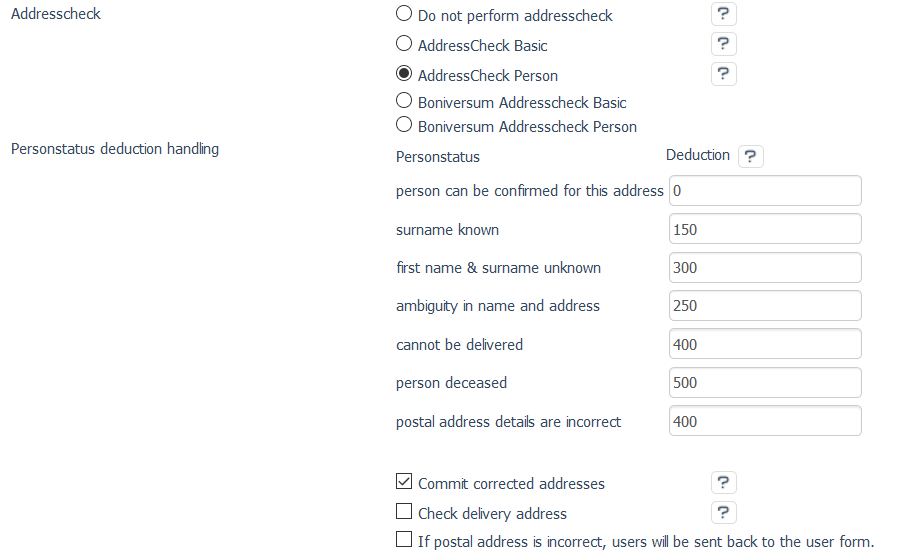
| Field | Description |
|---|---|
| Address Check | Do not perform address check - No address check is performed. AddressCheck Basic - Address check for existence (street number, postcode, city, country) as well as addition and correction of address (possible for addresses from Germany, Austria, Switzerland, the Netherlands, Belgium, Luxembourg, France, Italy, Spain, Portugal, Denmark, Sweden, Finland, Norway, Poland, Slovakia, Czech Republic, Hungary, USA, Canada). AddressCheck Person - Checking whether the person is known at the address given, checking the existence of the address and supplementing and correcting the address (Germany only). Boniversum Addresscheck Basic Boniversum Addresscheck Person |
| Commit Corrected Addresses | An address corrected by the PAYONE platform is adopted |
| Check Delivery Address | A different delivery address will also be checked on the basis of the selected address check.
If the option "Apply corrected address" is selected, corrected delivery addresses will also be applied.
|
| If Postal Address is Incorrect | If the described condition applies, the user is asked again to enter his invoice/delivery data in the checkout. |
Bank Details Check
Here you can configure whether and in what form bank details should be checked during the checkout process when the payment type Direct Debit is selected.

| Field | Description |
|---|---|
| Check Bank Account | Inactive - No check of the bank details Active - The system checks the plausibility of the account details. No check is made for the existence of the bank details or account coverage.
Active, with check against POS CRL - A check of the bank details for plausibility and a check against the POS block list is performed.
Here, too, no check is made for the existence of the bank details or coverage of the account. The POS block file contains account connections with open chargebacks from stationary trading.
|
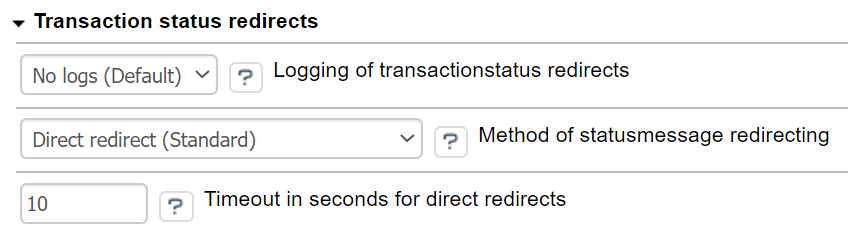
| Field | Description |
|---|---|
| Logs | With this option activated, you can log activity of transaction status redirects. Content of this logging are landing in file fcpo_message_forwarding.log in your shops log folder. |
| Redirect Method | Direct redirect - Using this method will directly redirect the transaction after receiving it. This mode offers a high redirection speed and a moderate transaction security. Delayed by Cronjob - Instead of directly redirecting the status message, this method collects incoming messages and will redirect them after calling a cronjob. This mode offers a very high transaction security. The speed of redirecting status messages depends on the setup of your server. |
| Timeout | For offering direct redirects without any interruptions, there is a need for having a timeout for mode "Direct redirects". |

Transaction status forwarding enables you to transfer the payment status to other systems, such as Materials Management or Logistics.

| Field | Description |
|---|---|
| Status | The status sent by PAYONE. |
| URL | Enter the receive URL to which the status is to be forwarded. |
| Timeout | Number of seconds to wait until the status is accepted. |
| Delete | Here you can delete the respective forwarding. |
| Save | Saving saves all redirects in the database. |
| Add | You can add as many redirects as you like. Also multiple forwarding for one and the same status. |

The transaction status mapping is used to use the PAYONE status in order to have the orders processed according to your needs in an appropriate shop status.
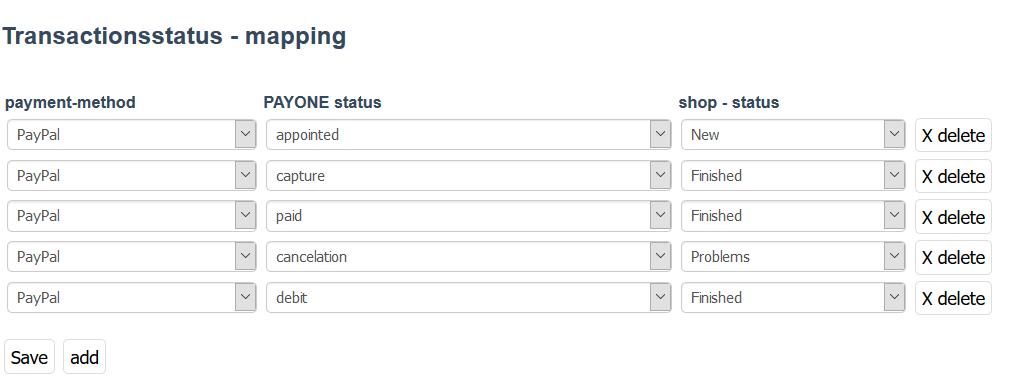
| Field | Description |
|---|---|
| Payment Method | The payment type for which the mapping is to apply. |
| PAYONE Status | The status sent from PAYONE to the shop. |
| Shop Status | The status that the orders should assume when the configured PAYONE request is processed in the shop. |
| Delete | Here you can delete the respective mapping. |
| Save | Saving saves all mappings in the database. |
| Add | You can add any number of mappings. Please note, however, that only one mapping exists for a payment type and PAYONE status combination. This may lead to inconsistencies. |
Within the menu item Protocols/Logs you will find all information about processed payments, the communication with the PAYONE platform as well as the order overview.
Transactions
The Transactions submenu item displays notifications received from the OXID eShop of the transaction status of the PAYONE platform for each order and transaction. If there are any errors, you can find out here whether the transaction status was received correctly and what the current status is for a transaction.
In the overview you can see all received and processed messages of the transaction status of the PAYONE platform. Filter options are available above the individual columns.
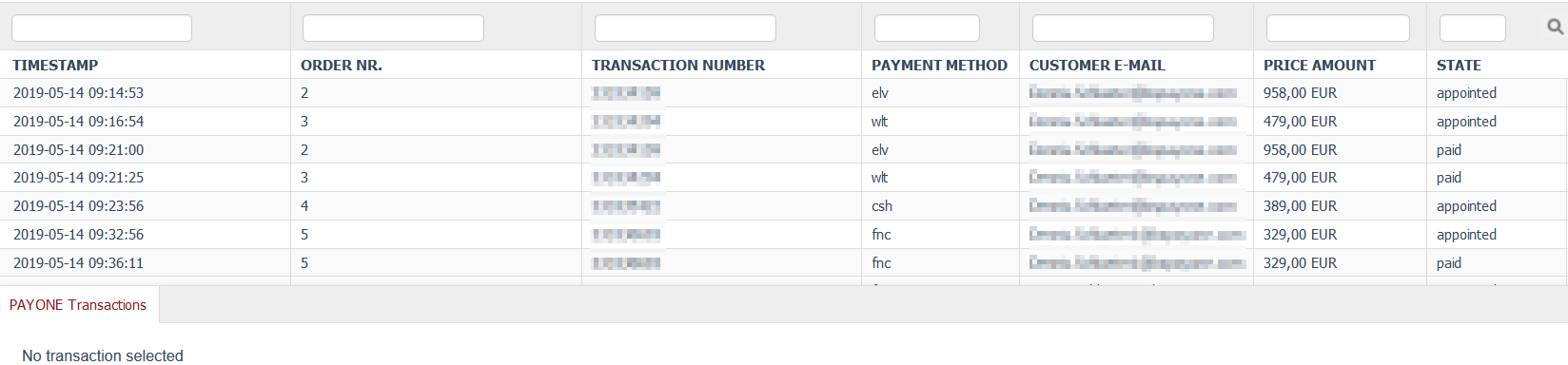
| Field | Description |
|---|---|
| Time | Time at which the transaction status was received. |
| Order Number | The order number of the order in the OXID eShop. |
| Transaction Number | The unique number of the transaction (TXID). This number is assigned by the PAYONE platform. |
| Payment Method | The payment type used within this transaction is displayed here. The following abbreviations are possible: elv - Direct debit cc - credit card rec - invoice cod - cash on delivery sb - online bank transfer wlt - e-Wallet (e.g. PayPal) fnc - Financing (e.g. Klarna) |
| Customer Email | The e-mail address of the customer that was specified in the order. |
| Amount | The amount in the currency used. |
| Status | This displays the status transmitted by the transaction status of the PAYONE platform.
An explanation of the individual statuses can be found in the technical documentation of the PAYONE platform in the PAYONE Merchant Interface (PMI) under Downloads → Documentation.
|
Transaction Details
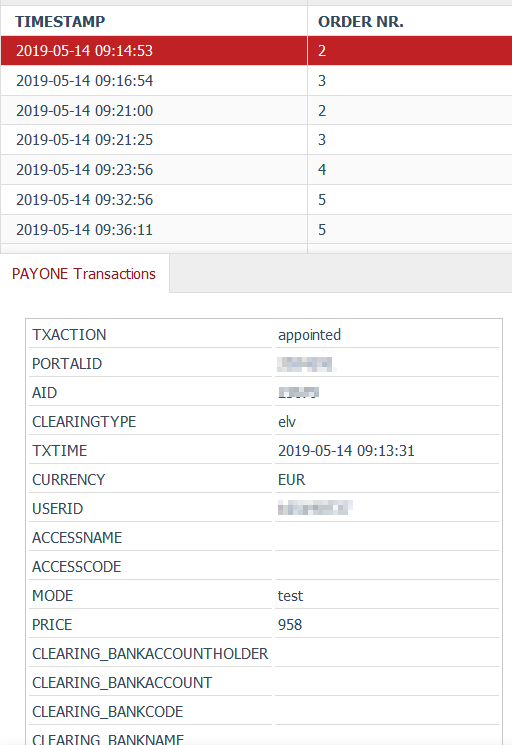
After selecting an entry in the overview, you will receive all transmitted transaction status information through the PAYONE platform to your OXID eShop. This allows you to track at any time which data your OXID eShop has received and processed.
A detailed explanation of the respective parameters can be found in the technical documentation of the PAYONE platform in the PAYONE Merchant Interface (PMI) under Downloads → Documentation.
API Logs
In the submenu API-Logs you will find all requests from the OXID eShop to the PAYONE platform as well as the corresponding answer of the PAYONE platform.
The only requests that are not contained in these logs are requests using the Client API. The reason for this is that these requests are sent directly from the buyer's browser (client) to the PAYONE platform for reasons of the Payment Card Industry Data Security Standard based on Ajax technology, so that your OXID eShop does not technically come into contact with sensitive credit card data.
In the overview you will find a list of all requests from the OXID eShop to the Server API with basic information. You can filter the display in the column headers by entering search terms.

The entire content of the Request and Response columns is searched. The content is described in more detail in the API log details.
| Field | Description |
|---|---|
| Time | Time of the request. |
| Channel | The channel used. |
| Request | Type of request. |
| Response | Parameter "status" from the response of the PAYONE platform to the request. |
API Log Details

After clicking on one of the requests listed in the overview, you will see all parameters of the request sent to the PAYONE platform as well as the corresponding response from the PAYONE platform.
Orders
The order overview is a standard functionality of the OXID eShop. The PAYONE tab has been added to this list in order to be able to check the payment status of an order.
Via the menu item Manage orders → Orders, which is available by default in every OXID eShop, the same overview including the PAYONE tab is displayed as under PAYONE → Protocols / Logs → Orders.

| Field | Description |
|---|---|
| Order Time | Time of order |
| Paid | Time for reporting the payment from the PAYONE platform. |
| Order No. | Order number of the OXID eShop. |
| Client | Name, first name of the customer. |
| PAYONE Reference Number | The reference number passed to the PAYONE platform for unique identification. The reference number is stored in the "reference" parameter. |
PAYONE Tab
In the PAYONE tab you will find the transaction account in the context of the order, in which all receivables and payments are displayed. This is based on the OXID eShop requests via the Server API to the PAYONE platform as well as feedback on the transaction status from the PAYONE platform.
You also have the option of capturing payments for pre-authorized payment transactions and refunds.

| Field | Description |
|---|---|
| Reference Number | The reference number passed to the PAYONE platform for unique identification. The reference number is stored in the "reference" parameter. |
| PAYONE Process Number (TXID) | The transaction number under which the transaction was processed in the PAYONE platform. |
| Method of Payment | Payment type with which the order was executed. |
| Payment Details | Depending on the payment method, detailed information about the payment is listed here. For credit card payments, the fields Card type and Masked card number are displayed here as information. |
| Amount | Depending on the payment status of the order, you can trigger a credit note (refund) or carry out a payment collection (capture) at this point.
In the accounts receivable management in the PAYONE Merchant Interface (PMI) there are more far-reaching possibilities for the execution of captures, refunds etc. available. In addition, you can trigger these transaction types via your merchandise management system or/and via the server API of the PAYONE platform.
|
| Transaction Account | All receivables and payments for the purchase order are displayed here in the form of a transaction account. All negative amounts are displayed in red. Click on "Time" to open the corresponding transaction status. |